
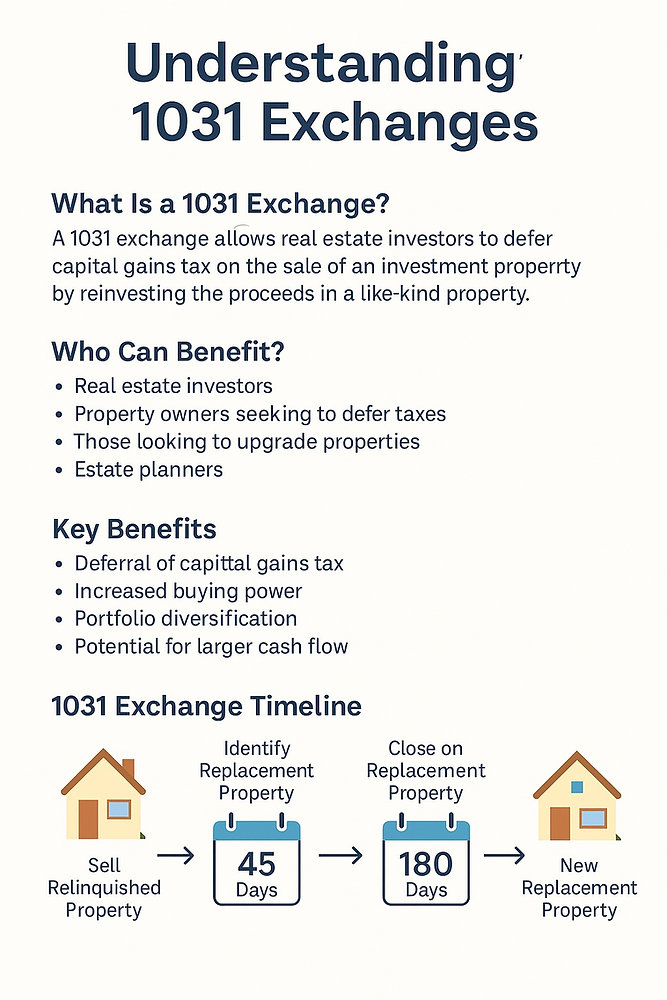
What Is a 1031 Exchange?
A 1031 Exchange (named after Section 1031 of the IRS Code) allows real estate investors to defer paying capital gains taxes when they sell an investment property—as long as they reinvest the proceeds into another “like-kind” investment property.
In simple terms:
You sell one investment property → reinvest all proceeds into another → and delay the tax bill until a future sale.
That means you get to keep your money working for you instead of sending a large check to the IRS.
Who Can Benefit From a 1031 Exchange?
A 1031 exchange isn’t just for the wealthy—it’s for any investor holding real estate for investment or business purposes.
You’ll benefit most if you are:
- A buy-and-hold investor looking to scale up your portfolio.
- A landlord ready to upgrade to newer or better-performing properties.
- A retiree wanting to trade hands-on rentals for passive income options (like NNN retail or DSTs).
- A California investor moving equity out of a low-yield market into higher cash-flow areas like Murrieta, Menifee, or Temecula.
- An estate planner seeking to defer taxes over time so your heirs can inherit with a stepped-up basis under current law.
The Basics - Part 1 or 2
The Key Benefits
A 1031 exchange is one of the most powerful tax tools available to investors. Here’s why:
💰 1. Defer Capital Gains Taxes
You don’t pay taxes on your profits when you sell—those taxes are deferred as long as you roll all proceeds into another investment property.
🚀 2. Maximize Your Buying Power
Because you’re not paying taxes upfront, you can use 100% of your equity to purchase the next property—helping you move into larger or more profitable assets.
📈 3. Grow and Diversify Your Portfolio
Upgrade from one home to several, or from small multifamily to commercial. You can adjust your holdings as markets evolve without losing ground to taxes.
🧩 4. Increase Cash Flow
Move from a low-return rental into something with stronger rent growth or a better tenant mix.
How a 1031 Exchange Works: Step-by-Step
🏠 Step 1: Sell Your Investment Property
You sell your existing investment property—but you can’t touch the proceeds. They must go directly to a Qualified Intermediary (QI).
⏱️ Step 2: Identify Replacement Properties (Within 45 Days)
From the closing date of your sale, you have 45 days to identify potential replacement properties. You can name:
- Up to 3 properties, any value, or
- Any number of properties as long as their total value is ≤200% of the one you sold.
🏗️ Step 3: Close on the Replacement (Within 180 Days)
You must close the purchase within 180 days of the original sale. This timeline is strict—no extensions.
📊 Step 4: Match or Exceed Value and Debt
To fully defer taxes, buy a property of equal or greater value and replace any debt you had on the old property (or add cash to cover the difference).
The Timeline at a Glance
Timeline
Key Task
What It Means
Day 0
Close on sale
Proceeds go to Qualified Intermediary
Day 45
Identify replacement property
Submit your list of potential replacements
Day 180
Close on replacement property
Finalize purchase to complete your exchange
(You can embed the infographic image here — “Understanding 1031 Exchanges”)
Common Mistakes to Avoid
❌ Missing the 45- or 180-day deadlines. These are absolute.
❌ Touching the proceeds. Money must go straight to your QI.
❌ Changing ownership. The same taxpayer/entity must sell and buy.
❌ Taking “boot.” Any cash or debt reduction becomes taxable.
Example: How Deferred Gains Grow
Imagine you bought an investment home for $100,000 ten years ago and sell it today for $1,000,000.
Instead of paying taxes on the $900,000 gain, you roll the entire amount into another property worth $1,000,000.Ten years later, that property doubles to $2,000,000, and you do another exchange into a $2,000,000 property.
Your cost basis continues to carry over—still around $100,000.If you later sell without exchanging, all deferred gains become taxable—but you’ve used the IRS’s money to compound your wealth for decades.
Is a 1031 Exchange Right for You?
A 1031 exchange is ideal if you:
- Own property held for investment or business use
- Want to reposition into better-performing assets
- Can identify and close on replacements within 45/180 days
- Are willing to work with a Qualified Intermediary and CPA
If you’re unsure, we can help you evaluate the tax savings and long-term return potential of an exchange in your specific situation.
🧭 Next Steps
At SoCal Realty & Investments, we help investors across California make confident, tax-smart moves with their real estate portfolios.
We’ll:
- Review your current holdings
- Calculate potential deferred gains and cash-flow improvements
- Connect you with vetted Qualified Intermediaries and tax professionals
- Identify high-performing replacement properties in SoCal markets